I must confess that my knowledge of Derrida is lacking, so I will leave further interpretation on JD's intention to more informed bloggers. I do, however, have a few thoughts on what I could glean from the quote and the rest of the post. Also, at the end I would like to add the kind of material I have been reading over the past few years so that you all can get an idea of where I will be coming from.
I first want to start out with a passage from "Philosophy of Mind" by philosopher of mind George Graham, who seems to be agnostic, in which he recounts an "after-death" experience by atheist philosopher A.J. Ayer:
"British philosopher A.J. Ayer expressed how astonished he was to have an after/near-death experience, but how equally anxious he was not to savour it. During the experience he seemed to emerge into a bright red light which was distressingly painful. Having 'returned' to his body he was dismayed at the prospect of having to die and perhaps experience the harsh light again. In an article which appeared in National Review in 1988, he wrote: 'My recent experiences have slightly weakened my conviction that my genuine death, which is due fairly soon, will be the end of me, though I continue to hope that it will be.'"
I find this entire quote interesting, but particularly the last clause from Ayer.
Once again deferring Derrida interpretation to others, the psychological effects of contemplating death are very interesting.
Regarding Shedd's post--particularly his point from Badiou--I suppose I will need further explanation of what 'thought' means in this instance. When one says that following the law is unthinking, I am guessing that this is some amended usage of the term 'thought', because it seems plain that abiding by a law involves recogniznig that such a thing is a law and the belief that one should follow the law, some sort of desire to follow the law...etc.--all of which are 'thought' processes.
I am guessing that 'thought' in this case means something more like 'meaningful, abstract contemplation'. It would indeed be an interesting question whether or not the concept of faith requires meaningful, abstract contemplation. One might think here of Alyosha in The Brothers Karamazov, and wonder how deep his contemplations were. Regarding the concept of grace, I suppose I do not understand how this requires contemplation or even thought on the part of the recipient--of course, this analysis is an analysis of the term, not an orthodox Christian understanding of what is required to obtain grace.
However, I think there is something very right in what Shedd is saying, particularly in how it pertains to the intellectually-inclined. Engaging the "and" is vital, I agree, and how we should do this is a valuable topic of conversation.
Is faith necessarily born of joy? I do not know. Dostoevsky and others seem to have been tormented by the interplay of faith and doubt--two sides of the same coin (another great paradox for FD).
As for my own reading: Although I continue to be interested in Continental Philosophy, I have not read Nietzsche for roughly two years now. I have read "Beyond Good and Evil" "Thus Spake Zarathustra" "Genealogy of Morals" "The Antichrist" and "Human, All too Human" by Nietzsche; "Fear and Trembling" "The Sickness Unto Death" and part of "Either/Or" by Kierkegaard. Other existentialist or continental thinkers I have read: Camus, Kafka, all of Dostoevsky, Paul Tillich, Martin Buber, very little Heidegger and very little Sartre. I have read existentialist psychologists Viktor Frankl and Alfred Adler. Others, such as Freud, Jung, Richard Rorty, Joseph Conrad and others seem to be only loosely tied to existentialism. I admit that I am rusty on just about all of these thinkers, so I look forward to having you all refresh me.
In the last few years I have become interested in philosophy of mind, philosophy of cognitive science and neuroscience, and more generally, psychology; so you can expect that my posts will draw off of my reading in these fields. Hopefully it will fit!
I have a suggestion for us all: join goodreads.com. It is an online community based on the books you have read. This includes ratings and reviews. Very useful, I would think, if we want to be familiar with what each of us is reading.
skip to main |
skip to sidebar
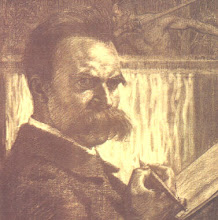


"Of all that is written I love only what a man has written in his blood. Write with blood, and you will experience that blood is spirit." -Zarathustra

Blog Archive
Contributors
No comments:
Post a Comment